


They don’t show up broken. They show up busy.
The high-functioning adults I see in residential treatment are rarely the ones you’d expect. They’re not crashing on couches or missing work. They’re leading teams, keeping family calendars, making lists, showing up. They’re the ones everyone else leans on.
Until the weight becomes unbearable.
At TruHealing at Rutherford, we work with many high-functioning adults—people who never “hit bottom” in the traditional sense but instead arrive at a quiet breaking point. Often, they’re not even sure they belong in a residential treatment program. They’re afraid it’s too drastic. That they’re not sick enough.
But behind the high performance is someone burning out—and underneath it all, someone who’s tired of pretending it’s fine.
You Don’t Need a Public Breakdown to Qualify for Help
This is the myth that keeps so many people from getting help: “I’m still functioning, so it can’t be that bad.”
But I’ve seen clients check themselves into residential treatment with a resume full of accomplishments and a nervous system running on fumes. I’ve worked with clients who haven’t missed a meeting in years but cry in the shower every morning.
The absence of chaos doesn’t mean the presence of health. Just because your life is still standing doesn’t mean it doesn’t hurt to live inside it.
Many of our clients describe it like this: “I feel like I’m wearing a mask made of my own accomplishments. And I don’t know how to take it off without everything falling apart.”
Perfectionism Isn’t Just a Personality Trait—It’s a Survival Strategy
Our residential program in in Baltimore, Maryland, one of the biggest “aha” moments comes when high-functioning clients realize their perfectionism isn’t just about standards. It’s about safety.
Somewhere along the way, they learned that achievement = worthiness. That control = survival. That showing emotion = weakness.
So they became masters of holding it together. Of over-functioning. Of anticipating needs and preemptively solving everyone else’s problems.
But what happens when there’s nothing left in the tank?
Residential treatment offers the time and space to ask that question. And more importantly—to answer it.
Inside the Crisis That Doesn’t Look Like a Crisis
Here’s what often brings high-functioning adults to our door:
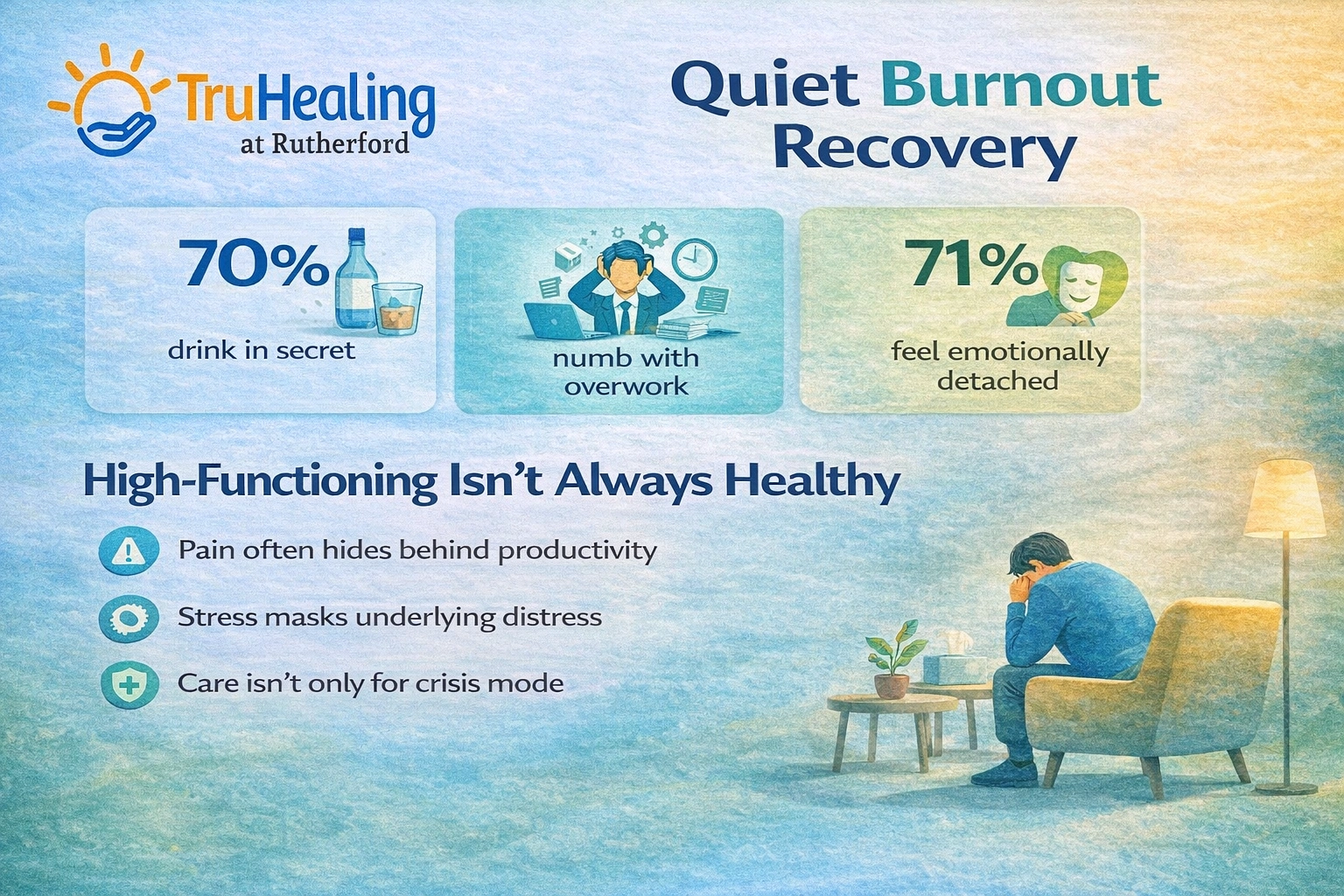
- Secretly drinking more than they admit
- Using work or productivity to avoid emotional pain
- Feeling detached from joy, even when “everything’s going right”
- Constant exhaustion with no medical explanation
- Anxiety that doesn’t respond to logic or problem-solving
- Fear of being “found out” for not being as okay as they seem
Sometimes it’s a health scare. Sometimes it’s a relationship falling apart. Sometimes it’s just that they wake up one day and realize: I can’t keep doing this.
And they don’t have to.
What a Residential Treatment Program Actually Offers
There’s a common fear among high-functioning clients: that residential treatment will mean giving up their identity. That stepping away from work, responsibility, and image means stepping away from who they are.
But in reality, residential care doesn’t take away who you are. It helps you finally meet the parts of yourself you’ve been avoiding.
At TruHealing at Rutherford, our program includes:
- 24/7 clinical and emotional support
- Individual therapy sessions that go beyond surface-level
- Group therapy with others who get it
- Holistic activities like mindfulness, movement, and creative expression
- Support with co-occurring issues like anxiety, depression, trauma, or burnout
- A chance to reset in a safe, structured, and stigma-free space
Many clients say they didn’t realize how exhausted they were until they had permission to rest.
Control Doesn’t Equal Clarity
One of the biggest shifts that happens in treatment? Releasing control without losing yourself.
Most high-functioning adults aren’t comfortable with surrender. They’re used to managing, fixing, optimizing. But residential treatment invites a different kind of strength—the kind that comes from slowing down, being honest, and letting other people in.
The predictable structure of treatment—daily groups, mealtimes, therapy sessions—offers stability. But within that structure is freedom. Freedom to feel. Freedom to not have the answers. Freedom to stop performing strength and actually build it.
What Real Healing Looks Like for High-Functioning Adults
Healing doesn’t mean you stop being successful. It means your success stops costing you so much.
Clients often describe a shift from white-knuckling through life to actually living it. From operating in survival mode to moving with intention and ease. From using substances or work or productivity to feel okay—to knowing that “okay” can exist without external validation.
It doesn’t happen overnight. But the first step often comes in the form of a question:
“What if I could do this differently?”
In our residential program, clients explore that question in ways that are both grounded and transformative. With support, structure, and safety, they begin to build a life that doesn’t hurt to live.
You’re Not Too Functional for Care
It’s easy to believe that residential treatment is for other people. For those who’ve lost jobs, families, control.
But here’s what I’ve learned after years of working in this field: the people who wait the longest to ask for help are often the ones who need it the most.
If you’re waking up exhausted. If your inner life feels hollow or strained. If your coping strategies have turned into crutches—you are not overreacting. You’re responding to a truth that’s finally too loud to ignore.
You don’t have to wait until you break.
What Clients Tell Me After Treatment
At the end of their stay, high-functioning clients often share things like:
“I didn’t know I could feel this calm without performing for it.”
“This is the first time I’ve rested without feeling guilty.”
“I thought I’d lose everything if I stepped away. But I found myself instead.”
They return to their lives—not as broken people patched back together, but as whole people reconnected to their worth, values, and clarity.
FAQs: Residential Treatment for High-Functioning Adults
Is residential treatment too intense for me if I’m not in crisis?
Not at all. Residential care is designed to prevent deeper crises as much as it is to respond to them. You don’t need to be at rock bottom to benefit.
Will I be surrounded by people with different struggles than mine?
Yes—and that’s often a good thing. Many clients find comfort in realizing that pain doesn’t look one way. You’ll likely meet people who are also high-functioning, even if their stories are different.
Can I work while in residential treatment?
Generally, no. We recommend setting work aside during your stay so you can fully focus on your healing. Our team can help you plan and communicate with employers if needed.
How long will I need to stay?
Most programs last 30–90 days, depending on your needs. We’ll work with you to find a timeline that supports your goals and responsibilities.
What happens after I leave?
We build aftercare into your plan from the beginning. That might include intensive outpatient (IOP), therapy, medication support, or peer community referrals. You won’t be left to figure it out alone.
Is this covered by insurance?
Often, yes. Our admissions team can verify your benefits and explain what’s covered. We make the process as clear and low-stress as possible.
You Don’t Have to Keep It Together Anymore
If you’re tired of performing “fine,” of working harder just to feel okay—know this: there’s another way.
Call (410) 431-3792 or visit Residential Treatment Program in Windsor Mill, Maryland to learn more about our services. You don’t have to break to begin. You just have to pause—and we’ll be right here when you do.