


I walked into treatment expecting transformation. What I got was truth.
Not the kind that hits you like a lightning bolt. The kind that sneaks in during quiet moments—when you’re not performing, not explaining, not trying to look like you’re “doing well.” At TruHealing at Rutherford’s residential treatment program in Windsor Mill, Maryland, I didn’t get “fixed.” But I did get something more honest. Something I could actually build on.
This is what I wish someone had told me before I packed my bags, full of expectation and fear: treatment is not a cure. But it can be a beginning.
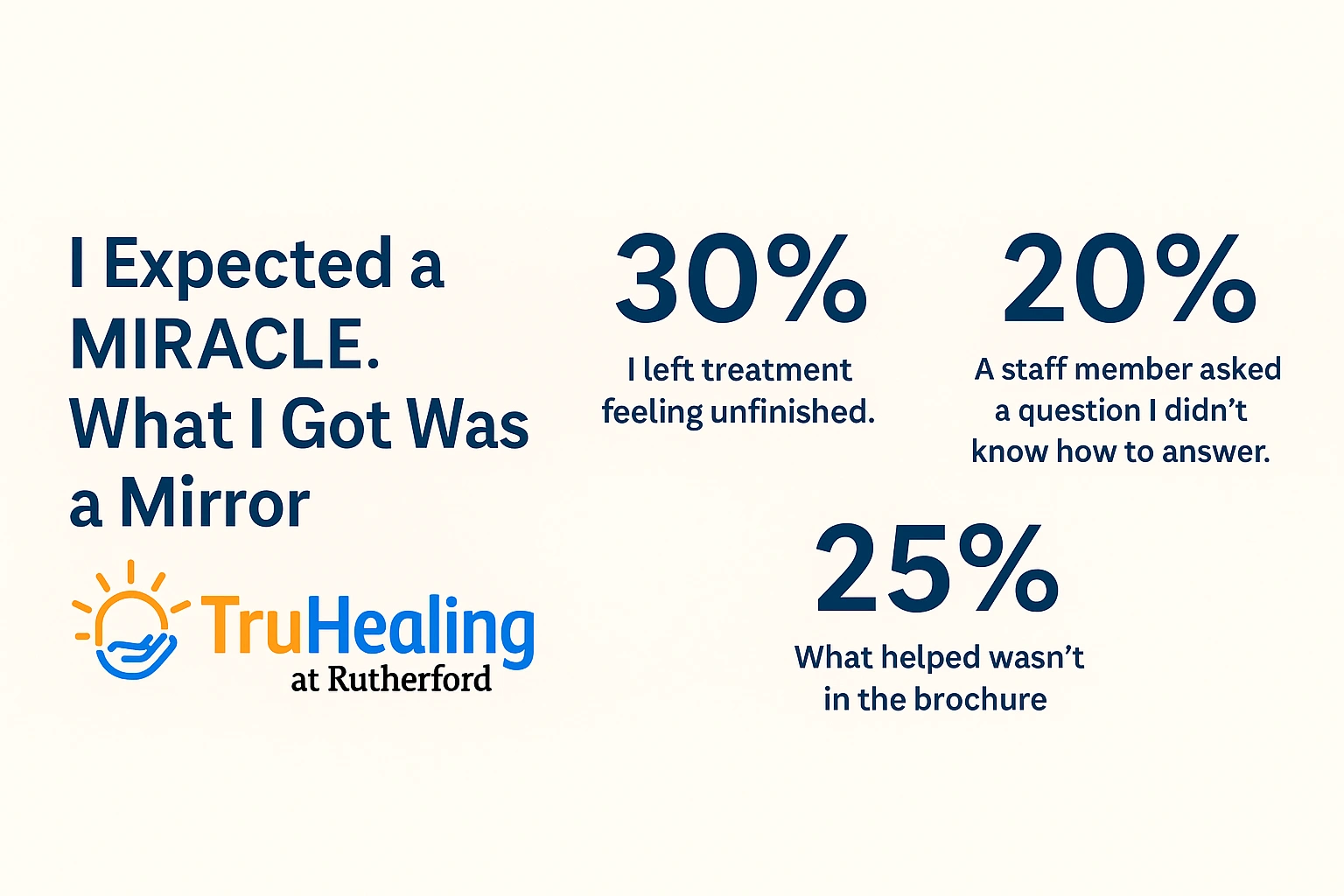
I Expected a Miracle. What I Got Was a Mirror.
I thought 30 days in residential treatment would wipe the slate clean. I imagined walking out clear-headed, full of insight, with no more cravings or confusion. I expected that whatever was broken inside me would finally be corrected.
Instead, I spent my first week in a fog. Detox was rough. Sleep was worse. I sat in groups wondering how everyone else seemed so open, while I felt like I was watching my life from underwater.
But then a few things started to crack through the numb:
- Someone in group said something that made me cry—not because it was poetic, but because it was real.
- A staff member asked me a question I didn’t know how to answer.
- I caught my own reflection and realized I hadn’t looked myself in the eyes in months.
That’s what residential treatment offered me: a mirror. Not for judgment—but for seeing, finally, where I was.
I Left Treatment Feeling Unfinished—And That Wasn’t Failure
Here’s the truth I didn’t know how to admit until months later: I didn’t leave treatment feeling “healed.” I left feeling tired, overwhelmed, and honestly… still unsure if I could make it.
But that doesn’t mean the program didn’t work.
It meant I was starting from the beginning—not the end.
Treatment didn’t “fix” me, but it gave me enough to start. Enough distance from the chaos to think. Enough structure to reset. Enough community to remember that isolation wasn’t helping.
That mattered more than I realized at the time.
What Actually Helped Wasn’t in the Brochure
When I first got there, I looked at the schedule like it was a contract. Therapy sessions, group check-ins, journaling prompts—I assumed if I did it all, I’d be better.
Some of it helped, sure. But what actually stuck?
- A casual talk with a tech during a late-night anxiety spiral.
- Watching someone else admit they weren’t ready to stop using—and still be treated with kindness.
- Sitting outside and realizing I could hear birds. That I was breathing.
These weren’t the milestones I expected. But they were the ones that mattered.
They reminded me that getting better isn’t always loud or visible. Sometimes it’s just noticing the world again.
Residential Treatment Didn’t Solve My Life—It Disrupted the Loop
Before I entered the program, everything felt like a blur of patterns. Use, regret, promise, repeat.
I knew the cycle. I hated it. But I also didn’t know how to stop.
Residential treatment interrupted the loop. It gave me structure where I had none. It gave me people to talk to when I normally would’ve spiraled alone. It gave me permission to stop performing and just exist for a while.
That disruption? That pause in the noise?
It’s what gave me a chance to make a different choice later—even when I messed up again.
Relapse Didn’t Mean It Didn’t Work
Let’s talk about the thing everyone whispers about but rarely says plainly: I relapsed after treatment.
Not immediately, but not long after either.
And for a while, I felt like I had failed. Like I wasted my time, and everyone else’s.
But over time, I realized something: the reason I came back again, the reason I knew how to reach out, the reason I didn’t stay stuck… was because of what I learned in treatment.
It didn’t fail me. It prepared me—for real life, not perfection.
And when I returned, I wasn’t starting from scratch. I was starting from something.
It Didn’t “Fix” Me. It Gave Me Room to Find Out Who I Am Without the Fog
I had this idea that treatment would hand me back a better version of myself. Instead, it gave me something else: room.
Room to notice what I had been avoiding. Room to speak without shame. Room to feel uncomfortable and not run.
And in that space, I started asking questions I never had before:
- What am I actually afraid of when I’m sober?
- Who am I when no one is watching?
- What kind of life feels possible if I don’t have to numb every hard thing?
The answers weren’t clean. They still aren’t. But they’re mine.
And they started in a place that let me slow down enough to hear them.
If You Think Treatment “Didn’t Work” For You—Maybe It Did More Than You Realize
It’s easy to say “treatment didn’t work” when your life still feels hard afterward. But sometimes, “working” doesn’t look like fireworks. Sometimes it looks like:
- Calling someone instead of using
- Crying in the shower instead of drinking to forget
- Showing up late to therapy instead of ghosting completely
Progress isn’t always pretty. Or linear.
Sometimes treatment just plants something that takes time to grow.
And if you’ve ever been in a residential treatment program—especially one like TruHealing at Rutherford—there’s a good chance it gave you more than you think.
FAQs: Real Answers for Real Doubts
What if I went to treatment and relapsed—did I fail?
No. Relapse isn’t a failure—it’s information. It shows something still needs care. The skills you built in treatment still exist, and you can use them to come back.
How do I know if a residential treatment program worked?
If it gave you any tools, any moments of clarity, or helped you pause your spiral—it worked. It might not have solved everything, but it interrupted the worst of it.
I didn’t feel “better” after treatment. Is that normal?
Yes. Feeling better takes time. Treatment isn’t the final chapter—it’s the start of the rewrite. Emotional numbness, doubt, or discomfort are common, especially early on.
Do I have to believe in it for it to help?
Nope. You can be skeptical. You can roll your eyes in group. What matters is showing up—even with doubts. Change doesn’t require full faith. Just enough willingness to stay.
Is it worth going again if I’ve already been once?
Yes. A second stay isn’t a setback. It’s a chance to go deeper with more self-awareness. Many people need more than one round of treatment—and that’s okay.
It Doesn’t Have to Be Perfect. It Just Has to Be Honest.
If you’ve been to treatment and it didn’t “fix” you, I see you.
But maybe that wasn’t the point. Maybe it gave you a foothold—a thread to pick up when you’re ready again.
And if you’re ready now?
Call (410) 431-3792 or visit our Residential Treatment Program page to see how TruHealing at Rutherford supports honest, no-pressure recovery in Windsor Mill, Maryland.
You don’t have to believe in miracles. You just have to show up.