


If you’re considering treatment, there’s a good chance you already know something needs to change. But knowing you need help doesn’t mean you’re sure about what comes next. That’s especially true when the next step is a Partial Hospitalization Program (PHP)—a term that might sound more intense than it actually is.
At TruHealing at Rutherford, we meet people every day who are anxious, uncertain, and afraid of what treatment might feel like. The first week can be full of questions: What if I can’t do this? What if I don’t belong here? What if it doesn’t work?
Let’s slow those fears down. Here’s what that first week of PHP actually looks like.
Orientation Is Gentle, Not Clinical
When you arrive for your first day, no one expects you to be energized, enthusiastic, or “on.” Most people walk in feeling fragile—tired, overwhelmed, maybe still unsure if they’ve made the right decision. That’s okay. That’s expected.
Orientation at TruHealing is about settling in, not testing you. You’ll meet with intake staff who will explain the program schedule, show you around, and answer your questions as they come. If you’re nervous about forgetting things, don’t worry—we walk you through everything more than once.
We don’t rush introductions or throw you into groups on the first hour. We take the time to help you feel safe. Because that’s the first goal: safety, not performance.
You’ll Meet Your Treatment Team
Within the first few days, you’ll begin meeting the people who will walk with you through treatment—your primary therapist, case manager, and clinical team. This is where we begin to build your individualized care plan based on what’s actually going on for you—not just a checklist of symptoms.
These conversations are real. Not robotic. We’ll ask about what brought you here, what’s been hard, what has (and hasn’t) helped in the past, and what you hope for—even if hope feels far away right now.
We also go over practical needs: housing, work, insurance, or legal concerns. Healing can’t happen when your basic needs feel like time bombs. Your team is here to help stabilize both your emotional and real-world situation.
Group Therapy Begins—But You’re Never Forced to Share
Group therapy typically starts within your first few days in PHP. It’s okay if you just listen at first. Participation is encouraged—but never required. You won’t be called out or spotlighted if you’re quiet. We know it takes time to feel safe enough to speak.
Group sessions are led by licensed professionals and often focus on topics like:
- Coping with triggers and cravings
- Identifying negative thought patterns
- Building healthier relationships
- Learning emotional regulation tools
- Processing trauma safely
You’ll be placed in groups with others at similar stages in their journey. It may feel intimidating at first, but many clients report group as one of the most healing parts of PHP. Hearing others articulate feelings you’ve struggled to name can be surprisingly powerful.
The Structure Helps Even When You’re Not Ready to Engage
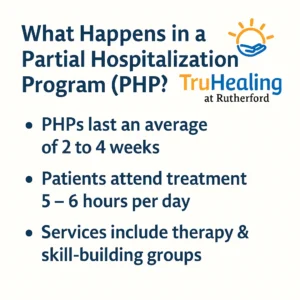
Partial hospitalization is structured—typically 5 to 6 hours per day, 5 days a week. That might sound like a lot. But for many people, that structure provides a kind of scaffolding when everything else feels like it’s falling apart.
In your first week, you might still be physically and emotionally unsteady. Sleep might be off. Appetite may not be back. Concentration could feel out of reach.
All of that is okay.
The structure isn’t meant to push you. It’s meant to hold you up until your system can start to breathe again. Many clients say it’s like finally sitting down after standing for too long—you don’t realize how tired you were until you feel held.
Medication (If Used) Will Be Evaluated Thoughtfully
If medication is part of your care—or might be—we’ll walk through that process gently. If you’re already on medications, our providers will review them to ensure they’re safe and supportive in your current context. If you’re not on any but open to trying them, we’ll discuss your options with you, not for you.
Our clinicians specialize in behavioral health and addiction recovery. We understand the fear that can come with medication—especially around feeling numb, losing your personality, or becoming dependent on something new.
You will never be pressured into taking medication. We respect your voice in your own care plan.
You May Start to Feel Less Alone
One of the hardest parts of struggling with addiction or mental health is the isolation. It often feels like no one really sees what you’re going through. Like you’re “too much” or “too broken.”
But in your first week of PHP, that sense of isolation can begin to shift. Slowly. Gently.
You may hear someone in group say something you’ve felt for years but never said out loud. You may feel the comfort of a therapist who truly listens without judgment. You may feel yourself exhale—for the first time in a while.
That’s not recovery yet. But it’s the start of belonging. And that’s enough to begin.
By the End of the Week, Familiarity Brings a Little Relief
You won’t have all the answers in the first week. You’re not supposed to. But by Friday, the space might feel a little more familiar. The faces around you a little less intimidating. The idea of being here—just for one more week—might not feel impossible anymore.
That’s the shift we hope for in week one. Not transformation. Not healing. Just this:
“I think I can keep going.”
And that’s more than enough.
Frequently Asked Questions About PHP
What does a typical day in PHP look like?
Most PHP days run from late morning to mid-afternoon. A typical day might include a morning check-in group, a psychoeducation session, lunch, process group therapy, and individual support sessions. Breaks are built in, and staff are available throughout the day for check-ins.
Do I have to talk in group therapy?
No. Sharing is always encouraged—but never forced. Many people start by listening and begin speaking when they feel safe.
Can I work or go to school while in PHP?
PHP is a daytime commitment, often 5–6 hours per day. Some people are able to balance part-time work or online classes in the evenings. If that’s important to you, we’ll talk it through during intake to find what’s realistic.
Is PHP the same as inpatient or rehab?
No. PHP is less intensive than inpatient care and doesn’t require overnight stays. You return home at the end of each day. It’s a step down from residential treatment and a step up from regular outpatient therapy.
What if I’m not sure this is the right level of care?
That’s okay. Our admissions team is trained to help assess your needs and recommend the level of care that fits best. PHP is one of several options—and we’ll help you find the one that truly supports you.
If you’re even thinking about seeking help, that means something in you is still reaching for life. You don’t need to have it all figured out. You just need someone who will walk with you through the beginning.
📞 Call (410) 431-3792 or visit our PHP program page to learn more about how TruHealing at Rutherford supports healing in Windsor Mill, Maryland.