

I thought my creativity was my addiction.
Substances made me feel electrified, open, raw—like I had access to something other people didn’t. My best writing happened after midnight. My boldest ideas hit mid-bender. I told myself I couldn’t create without the chaos.
But I was wrong. And I didn’t realize that until I got help through a residential treatment program in Windsor Mill, Maryland.
I Used to Think Sobriety Would Flatten Me
If you’re reading this and you’re scared that sobriety will erase you—your edge, your imagination, your spark—I need you to hear this: I get it.
I was terrified that recovery meant becoming someone else. Someone boring. Someone beige.
When I imagined treatment, I pictured silence. Cold rooms. No laughter. No color. No music.
So I avoided it. For years.
Even though I was unraveling. Even though I couldn’t finish a song. Even though I was using just to feel normal. Even though people I loved stopped picking up the phone.
It didn’t matter—I wasn’t ready to give up the one thing I thought made me special: my art.
But My Art Wasn’t Free—It Was Held Hostage
Here’s what I couldn’t admit to myself: I wasn’t writing. I wasn’t creating. I was surviving—and barely. I’d sit in front of a blank page, panic rising in my chest, and tell myself I’d find the words after one drink, or one pill, or one line.
Sometimes I did. But more often, I just spiraled. I wasn’t in control anymore. And deep down, I knew it.
What I once called “my process” was really just dependency wrapped in glitter.
What Changed in Residential Treatment
TruHealing at Rutherford wasn’t what I expected. Their residential treatment program didn’t sterilize me. It didn’t strip me of who I was.
Instead, it slowed me down—on purpose.
I didn’t have to perform. I didn’t have to prove I was still “creative.” I just had to be there. Day by day.
And something strange happened in that quiet: my creativity started coming back. Not with fireworks, but with tiny sparks of curiosity.
One night, I picked up a pen—not to impress anyone. Just to see what might come out.
That was the beginning.
Recovery Rewired My Relationship With Creativity
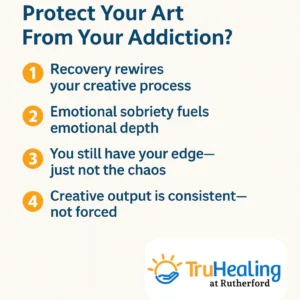
I used to think chaos made me creative. But treatment helped me see the truth: my creativity never needed chaos. It just needed safety.
In residential treatment, I learned:
- Structure isn’t the enemy of art—it’s the container that holds it.
- Emotional sobriety gives me access to feelings I used to numb.
- Community can be more inspiring than isolation.
- Creativity in recovery isn’t less intense—it’s just less destructive.
Today, I still write. I still perform. But it doesn’t cost me everything.
I’m Still Me—Just Not Drowning
I used to think sobriety would erase the messy, loud, passionate parts of me.
Instead, it gave me back access to all of it—without the fog.
There’s a scene I always return to: me in the group room, legs tucked under me, sketching a scene I’d been dreaming about for weeks. It was quiet. The good kind of quiet. And for the first time in years, I wasn’t creating to escape—I was creating to connect.
That’s what recovery gave me. That’s what residential treatment held space for.
A Note to Artists Afraid to Get Sober
If you’re clinging to your addiction because it feels like your muse, I see you.
If you’re terrified that sobriety will make your art bland, I hear you.
If you’ve been told you’ll “find better inspiration sober” but secretly think that’s BS, I was right there with you.
What shifted for me wasn’t the art. It was the why behind it. My creativity is sharper now. More truthful. And I don’t have to suffer to access it.
What Makes TruHealing at Rutherford Different
I didn’t want to feel like a patient. I wanted to feel like a person.
At TruHealing’s residential treatment program in Windsor Mill, I got that. Their team wasn’t cookie-cutter. They met me where I was. They didn’t rush my process. They didn’t try to fix me—they helped me reconnect with myself.
And being around other people who “got it”? That helped more than I can explain.
I still stay in touch with a few of them. We trade poems and voice memos and rough drafts. We remind each other that creativity doesn’t end with recovery. If anything, it starts there.
Frequently Asked Questions About Residential Treatment for Creative People
Will I lose my creativity if I get sober?
No—and that fear is more common than you think. Many artists, musicians, writers, and performers worry that substances are tied to their creativity. In reality, addiction often blocks consistent access to creativity. Sobriety can offer more clarity, presence, and emotional depth—without the chaos.
What’s different about a residential treatment program?
A residential treatment program provides 24/7 support in a structured, healing environment. At TruHealing at Rutherford, that includes individual and group therapy, creative expression opportunities, wellness support, and a safe space to explore recovery without outside triggers.
Can I bring my art supplies or instruments?
Most treatment centers allow some form of creative expression—especially if it’s part of your healing process. At TruHealing, I had access to journals, art materials, and plenty of space to create. They understood that healing is holistic—and that includes your identity as an artist.
What if I don’t want to talk in groups?
That’s okay. You don’t have to be the loudest person in the room to heal. Some of the deepest shifts happen through listening, reflecting, and connecting in your own way. Residential treatment is about meeting you where you are—not forcing you into a box.
How long is the program?
Length can vary based on your needs, but many residential programs last between 30 and 90 days. The team at TruHealing works with you to build a plan that makes sense for your goals and life situation.
📞 Ready to protect your art without losing yourself?
Call (410) 431-3792 or visit our Residential Treatment Program services in Windsor Mill, Maryland to learn how TruHealing can support you.