


When your child is in a behavioral health crisis, the fear is instant—and all-consuming. You’re not just worried. You’re terrified. And the question hits like a siren: “Where do we go?”
If you’re here, it means something serious is happening—and you’re trying to make the right call. Below, we’ll walk gently through the differences between a residential treatment program and emergency room care, so you can feel more grounded in a moment that feels anything but.
TruHealing at Rutherford offers residential treatment services in Windsor Mill, Maryland, and we’re here to help you understand your options—without pressure, and without judgment.
ERs Handle Acute Safety. Residential Programs Provide Space to Heal.
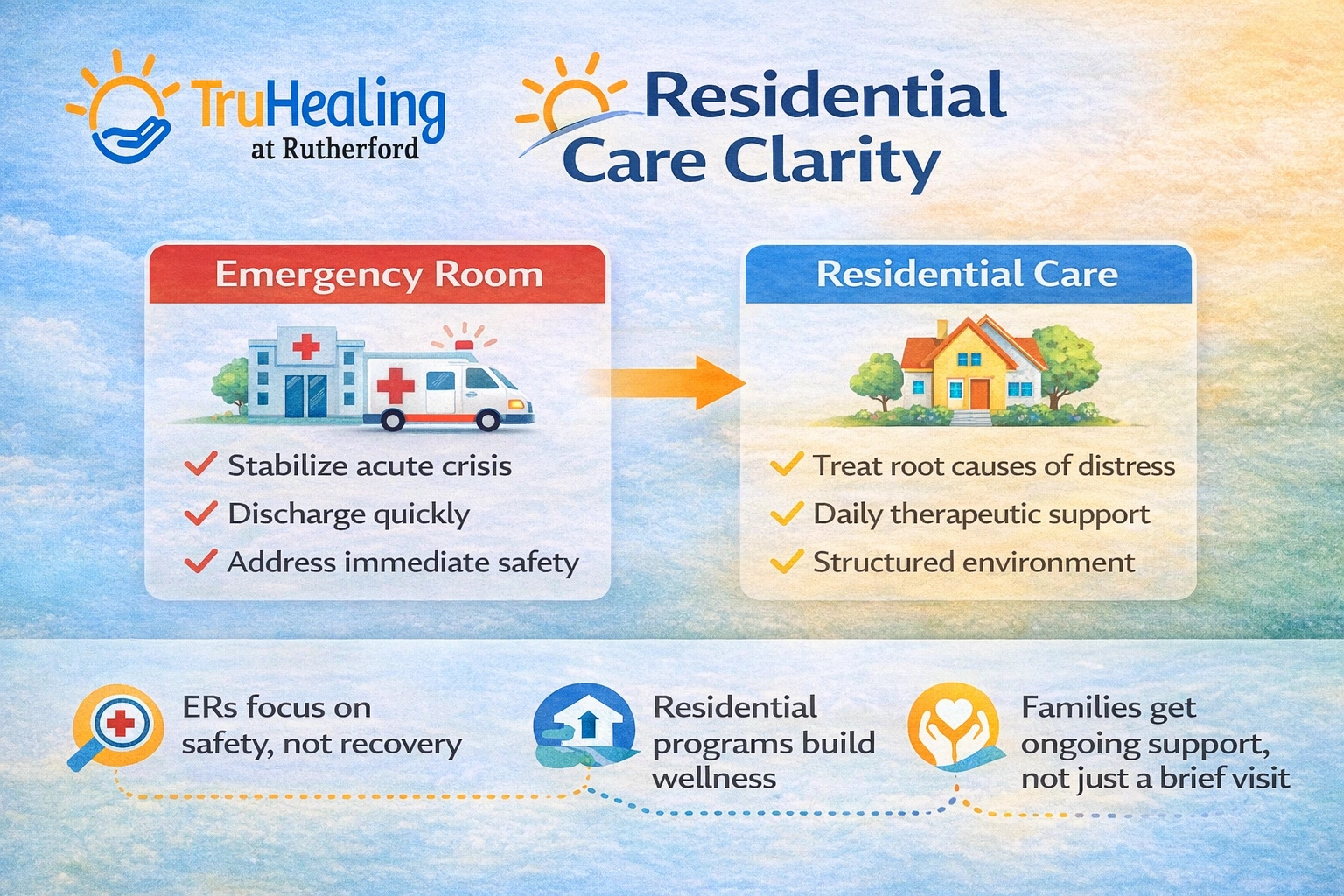
In a behavioral health emergency—like suicidal thoughts, a psychotic episode, or uncontrollable emotional distress—the emergency room is the right place. Their job is to triage, stabilize, and address immediate risk.
But that’s where their role ends.
Emergency rooms aren’t designed for ongoing healing. There’s no extended therapy, no trauma processing, no structured support system. Often, after a brief stay and some paperwork, your child is discharged—sometimes with a referral, sometimes without.
That’s where residential treatment programs come in.
A residential treatment program gives your child more than a Band-Aid. It gives them the time, support, and structure to actually work on what’s underneath the crisis—whether that’s anxiety, depression, trauma, or something they haven’t been able to name yet.
The ER Isn’t the End of the Crisis—Just the Beginning of Care
It’s easy to feel relief when the ER discharge papers say “stable.” But emotional and psychological stability is more than a vital sign.
Many parents describe a painful cycle: their child goes to the ER, gets stabilized, comes home… and then the same crisis happens again weeks—or even days—later.
The problem isn’t you. And it’s not them.
The problem is that emergency rooms were never meant to treat the why. They treat the what now. And that difference matters.
A residential treatment program can help interrupt that cycle. It offers:
- Daily therapy sessions
- Safe medication management
- Skill-building for emotion regulation
- Peer support and therapeutic structure
- A contained, distraction-free environment
- Coordination of care for underlying diagnoses
It’s not just about keeping them safe. It’s about helping them feel safe enough to grow.
You’re Not Supposed to Do This Alone
When your child is struggling, it’s natural to want to protect them at all costs. You try to keep them home, keep things calm, fix what you can.
But sometimes love means letting go of the things you can’t carry—and trusting someone else to help.
Choosing a residential treatment program doesn’t mean you’re giving up. It means you’re saying: “My child deserves more than I can give them at home right now—and that’s okay.”
At TruHealing at Rutherford, we work with families like yours every day. And we never forget that you’re part of the healing process too.
What Does Residential Treatment Actually Look Like?
If the term “residential treatment” brings up images of cold institutions or locked hospital wards, it’s time to replace that picture.
Modern residential treatment is designed to be calm, supportive, and deeply respectful of the people inside. At TruHealing at Rutherford, our environment feels more like a healing campus than a hospital. Clients have privacy, structure, and access to care—not just for the crisis moment, but for the mental health conditions that led to it.
A day might include:
- Morning meditation or grounding activity
- One-on-one therapy
- Group processing sessions
- Educational workshops on emotional regulation, boundaries, and coping
- Time for rest, recreation, and reflection
- Family sessions (in-person or virtual) to reconnect and rebuild
No two clients have the same plan—because no two people are the same. Our team builds each treatment plan around the unique needs of your loved one.
Why Residential Treatment Matters for Young Adults
Young adulthood is a strange, volatile, and powerful time. It’s when mental health conditions often first emerge—or worsen. But it’s also a time when identity, independence, and trust are especially fragile.
In this stage of life, a crisis can derail not just today, but tomorrow’s future.
That’s why residential treatment can be so valuable. It provides a stable space to:
- Learn to navigate mental health with self-awareness
- Interrupt harmful patterns before they become ingrained
- Practice emotional and relational skills in real time
- Rebuild confidence and direction
It’s not just about surviving a crisis—it’s about building the capacity to face what’s next.
Residential Treatment in Windsor Mill, Maryland: Local, Connected, Compassionate
TruHealing at Rutherford is proud to offer residential treatment programs for teens and young adults in Windsor Mill and surrounding Maryland communities. We work with local families, schools, and providers to ensure care is coordinated and community-connected.
Whether you’re calling from Baltimore, Catonsville, or right here in Windsor Mill, our team is ready to walk with you through this.
Learn more about our residential treatment program services in Windsor Mill, Maryland.
FAQs: Residential Treatment vs. Emergency Room Care
Is the ER ever the wrong choice?
No. If your loved one is in immediate danger—to themselves or others—the ER is always the right first step. It’s the place to stabilize physical and psychological risk. But for ongoing support, it’s not enough.
How do I know if my child is “sick enough” for residential treatment?
If your child’s symptoms are interfering with daily life, relationships, or safety—and outpatient therapy isn’t helping—it’s time to ask about residential care. You don’t need a certain diagnosis or label to deserve help.
What if my child doesn’t want to go?
This is hard—but common. Many young adults resist the idea at first. We can help you have that conversation, and in some cases, help assess whether legal or medical holds are necessary. But more often than not, fear is the real barrier—not refusal.
How long does residential treatment last?
Most programs last 30–90 days, but it depends on your child’s needs and progress. We believe in flexible, client-centered timelines—not cookie-cutter stays.
What happens after residential treatment ends?
We plan for aftercare from the start. That might include step-down care like PHP or IOP, a return to outpatient therapy, or academic/work reintegration with support. Our goal is not just crisis resolution—but long-term resilience.
Will insurance cover this?
Residential treatment is often covered by insurance, though coverage varies. Our team can verify your benefits and walk you through the process step by step. You don’t have to figure this out alone.
When You’re Scared, Clarity Is a Kindness
If your child is in crisis, you don’t need vague advice. You need calm, experienced voices who can help you move from panic to plan.
At TruHealing at Rutherford, we’ve helped hundreds of families in moments like this. We don’t take your trust lightly. And we don’t believe in one-size-fits-all solutions.
We believe in your child’s capacity to heal—and your family’s ability to find peace again.
Call (410) 431-3792 or visit Residential Treatment Program in Windsor Mill, Maryland to learn more about our services in Windsor Mill, Maryland. You’re not alone. We’re here—and we know the way forward.